Article
How Can AI Improve Customer Experience?
⏱ 7 minute read
The answer starts not with technology, but with intention.
AI can improve customer experience by helping organisations understand customers more clearly, remove friction, anticipate needs and create more space for human presence. But it only improves the experience meaningfully when it is guided by a clearly defined human intention.
Whether we call it customer, client, occupier or visitor experience, the question is increasingly the same: how can AI help us make it better?
In essence, this is a newly framed version of an old question. In Penshee’s ten years of existence, barely a week has gone by without someone asking us some version of it: “How can technology improve the experience we create?”
Today, the technology in question is AI. But before we rush to answer, we should pause over one word in the question: improve.
Start with intention, not technology
What do we mean by improve? Faster? Easier? More consistent? More profitable? More memorable? More personal? More brand-aligned? Or do we mean better aligned with the feeling an organisation intends to create?
Without answering that first, “Where can we deploy AI?” is the wrong place to begin.
The better question is: what experience are we trying to create, and what do we want people to feel?
This is where customer experience consulting should begin. Not with the tool. Not with the platform. Not with the latest possibility. But with intention.
Because customer experience is not ultimately measured by the technology used to deliver it. It is measured by the feeling it leaves behind.
Technology should not compensate for a lack of care
I remember an on-site meeting at a leading financial institution where our own welcome had been wanting for any real sense of care or expectation. Yet the premise of the client’s brief was: “Can you help us build an occupier app to improve the experience in the building?”
Politely, our response was: “Not yet.”
Not because an app could not play a role. It might well have done. But because technology should not be asked to compensate for an absence of intention. If the welcome does not yet feel considered, expected or cared for in person, the answer is unlikely to begin with a new interface.
This is often the challenge with customer experience solutions. They can be useful, powerful and even transformative. But only when they are solving the right problem.
If the problem is friction, technology may help.
If the problem is poor information, AI may help.
If the problem is inconsistency, better systems may help.
But if the problem is a lack of care, culture or clarity, the answer is unlikely to be technology alone.
What is one way AI improves the customer experience?
One way AI improves the customer experience is by helping people become more prepared for the moments that matter.
The best technology in customer experience is often the technology you do not notice. It works quietly in the background. It removes friction and reduces uncertainty. It gives people confidence and allows the human part of the experience to come forward.
I think of the digital bag drop at Heathrow Terminal 5. The process was utterly simple: crystal-clear prompts, one step after another, and a final reassurance that our bag was on its way to Lisbon. It answered the question every passenger quietly carries when surrendering a suitcase to the system: “Will I ever see this again?”
And running alongside this was the detail that made the process feel like an experience: a friendly British Airways colleague nearby, available to catch the eye of passengers and keep them on track, and, importantly for us, chatting with our children about their plans for their holiday.
That is the point. The technology did not replace the human experience. It created space for it.
When technology interrupts presence
By contrast, we have seen countless visitor journeys where a digital sign-in system creates a sudden spike of awkwardness in an otherwise human-centred experience.
The guest arrives.
The host is present.
The opportunity for welcome is alive.
Then everyone turns towards a screen.
In that moment, technology has not created efficiency. It has interrupted presence. It has disempowered the team member and made the visitor do administrative work at the very point they should be feeling expected.
This is an important distinction. Not all customer experience solutions improve the experience. Some simply move effort from the organisation to the customer. Some make the process more measurable but less meaningful. Some create data while diminishing connection.
Good technology should help people feel more considered, not more processed.
How are companies using AI to enhance customer experience?
Companies are using AI to enhance customer experience in a range of ways. These include:
- analysing customer feedback and identifying recurring themes;
- turning operational data into customer experience insights;
- helping teams anticipate needs before they are expressed;
- reducing repetitive administration;
- personalising communication and support;
- highlighting friction points across a journey;
- giving frontline teams better information at the right moment;
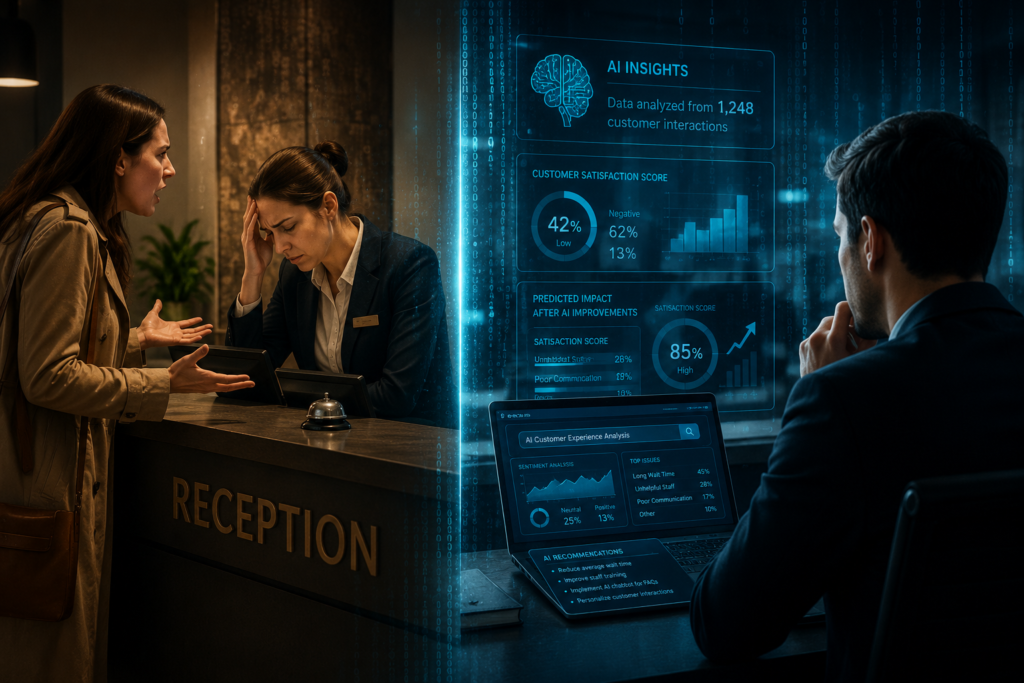
- oh, and of course, generating images for LinkedIn articles!
Each of these can be valuable in its own right. Marginal gains matter, especially in complex customer journeys where small points of friction can quietly shape the whole experience. But their greatest value comes when they are connected to a clear intention: the feeling the organisation wants to create.
Customer experience insights are most useful when they help an organisation act with greater intention. A better dashboard does not automatically create a better welcome. A smarter system does not automatically create a stronger culture. More data does not automatically lead to more care.
AI becomes most useful when it helps an organisation deliver the experience it has deliberately chosen to create.
The best customer experience solutions create presence
This is where AI may become genuinely valuable. Not as a novelty or as a substitute for care, but as a means of creating the conditions for presence.
The present moment matters because it is the only place an experience can happen. A welcome does not take place in a system, a dashboard or a process map. It takes place in the live moment between people.
Used well, AI can help protect that moment. It can reduce the administrative burden on teams. It can reveal patterns that would otherwise be missed. It can help a host understand that the last visitor wanted to get to the meeting room quickly and in silence, while this one may need settling, reassurance or a more generous welcome.
In that sense, the role of AI is not to make the experience feel more technological. It is to help the experience feel more considered.
For customer experience consulting companies, this is where the work becomes both strategic and human. The question is not simply which customer experience solution to buy or deploy. The question is how each tool, system, process and behaviour supports the feeling the organisation wants to create.
The paradox of better technology
There is also a paradox here. The more capable technology becomes, the more valuable genuinely human moments may feel.
We are impressed by new technology for a while, but very quickly it becomes normal. Automatic doors, online boarding passes, contactless payment, climate control, Google Maps, Uber: each may once have felt remarkable. Now we barely notice them unless they fail.
What remains is not the technology itself, but the feeling it enables or obstructs.
So yes, AI can improve customer experience. But only if we resist the temptation to treat it as the experience itself. It cannot substitute for the hard work of defining a vision, building a culture, training people well, designing thoughtful operations and creating places where people feel genuinely cared for.
If AI is used to remove friction, increase anticipation and create more space for human presence, it may be a powerful tool.
But if it is used to paper over a lack of care, clarity or culture, it will simply give us a more sophisticated way to deliver an experience that was never properly understood in the first place.
And perhaps this is the deeper invitation.
As AI becomes more embedded in the way we work, communicate and serve, the question is not only whether it can behave more like us. It is whether we can use it without becoming less like ourselves.
Because the real promise of AI in customer experience is not that it makes the experience less human. Used well, it may help us protect the very things that make experience matter in the first place: attention, anticipation, care, presence and connection.
Key takeaways
- AI can improve customer experience when it helps organisations remove friction, anticipate needs and create more space for human presence.
- The best customer experience solutions are not always the most visible. Often, the best technology works quietly in the background.
- Customer experience insights are most valuable when they help an organisation deliver the feeling it intends to create.
- AI can create marginal gains across feedback, personalisation, administration and journey design, but its greatest value comes when those gains are connected to a clear experience intention.
- Before asking “Where can we deploy AI?”, organisations should ask: “What experience are we trying to create, and what do we want people to feel?”