Article
Customer Service vs Customer Experience: Why Getting It Done Is Not the Same as Getting It Right
⏱ 9 minute read
Why This Conversation Is Important
Experience is a word we hear everywhere. Across almost every industry, organisations are thinking about it, talking about it, and trying to improve it.
It seems that all you need is a category, audience, or context, add the word “experience” to the end, and voilà. Consider customer experience, guest experience, employee experience, visitor experience, or workplace experience.
Now, that is a positive evolution. It means more leaders are paying attention to how people feel when they move through their spaces, services and customer touchpoints.
But there is still a problem. Experience is often misunderstood because it’s a nebulous concept, without a single, widely shared definition. Therefore, it is often confused with simpler concepts that are easier to define like service.
This matters because unclear definitions lead to poor decisions. If organisations mis-define experience, they risk designing for the wrong outcome, training teams towards the wrong ambition, and measuring the wrong signals.
You may train teams to do the task, but not to understand the person. Measure whether a standard was met, but not whether the moment felt right. Believe the experience is working because the service happened.
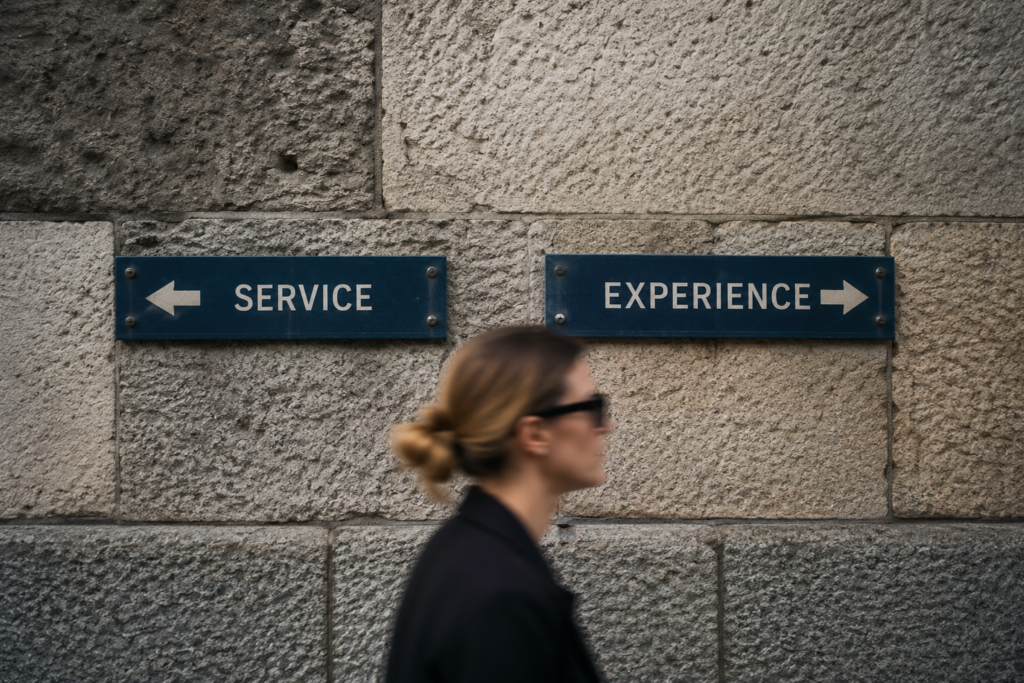
That is where service and experience begin to diverge. One is concerned with delivering what is needed; the other with how that delivery is understood, felt and remembered.
But getting it done is not the same as getting it right. So, let’s put the difference to bed.
What Is Customer Service?
Service is what is provided to meet a need. It may be a product, a task, a process, a piece of support, or an act of expertise. It is often part of an exchange for time, money, or value: someone asks, orders, arrives, pays, needs or expects something, and the organisation provides it. A coffee is made. A visitor is signed in. A meal is served. A question is answered. A problem is resolved.
This is service – it is what gets delivered. This is important because it gives teams clarity on what they need to do and gives the people you serve confidence that their basic needs will be met.
If service fails, the support people receive or the expectations they have usually are impacted. If the wrong dish arrives, the visitor pass does not work, the room is not ready, or no one can answer the question, the person is likely to feel frustrated or unsupported. So, to reiterate this is not an argument against service.
However, while service helps to ensure that the task gets done, it does not guarantee that the moment will feel meaningful, memorable or even particularly good.
In other words, service is the floor, not the ceiling.
What Is Customer Experience?
Experience is harder to define because it is not one single thing. It is not just a moment, place, service, process, or interaction. But how someone feels as they move through those elements, shaping customer perception, and what they are left feeling afterwards.
It is influenced by the entire customer journey; the people they meet, the environment they enter, the systems they use, and the expectations they arrive with. It is conscious and unconscious. It is practical and emotional.
What Is the Difference Between Customer Experience and Customer Service?
Service is delivered to someone: the right dish, to the right person, at the right table. While experience happens with someone. We often discuss with our clients how experience requires active participation and engagement, which is an important distinction.
A person is not simply receiving an experience like a coffee or croissant handed across a counter. They are involved in it. They bring their mood, memory, needs, confidence, sensitivities, preferences and expectations into the moment. At the same time, the organisation is expressing itself through its people, spaces, systems, language and behaviours.
The experience unfolds through customer interactions, at the point where the organisation and the person meet. That is where engagement matters. Experience depends on whether the organisation is paying attention to the person, the moment and the feeling being shaped.
- The receptionist noticing that someone looks unsure
- The waiter sensing that a family is open to warmth and humour
- Effective signage that is helping someone feel supported rather than confused
This is why two people can follow the same steps of service and create two completely different experiences. One person can make a guest feel like a task to complete. Another can make them feel expected, understood and cared for.
Why Experience Cannot Simply Be Standardised
This is where organisations can get caught. When they want to improve experience, they often try to create more standards, scripts, steps and instructions.
Sometimes that helps, but only up to a point.
Imagine a guest in a restaurant asks what the sauce is on their dish because they clearly love it. Service is answering the question correctly. Experience might be noticing how much they enjoyed it and, if the moment is right, delivering them a little more before the plate is cleared.
That could be a small, generous and memorable moment. But you cannot turn it into a rigid rule or service step.
You cannot say, “Every time someone asks about a sauce, bring them more sauce.”
What if they have already finished the dish? What if the moment has passed? What if it would feel awkward? What if they were simply curious and did not want any more?
This is why experience requires judgement.
It is not about creating a rule for every possible situation. It is about giving people clear guardrails, so they understand what the organisation is trying to make people feel and have the confidence to respond to the person and the moment in front of them.
Otherwise, if organisations focus only on the processes that underpin service, they design for operational reassurance. That the defined outcomes – often arbitrary -have happened but may miss the emotional impact it had on the person receiving it.
That is why standards should support judgement, not replace it. Standards give teams clarity and confidence. They help people understand the basics. But they should not become the whole ambition.
A Real-World Example: One Lunch, Two Experiences
Recently, we went to a high-end French bistro in London as a family to celebrate Father’s Day.
In one lunch, we saw the difference between service and experience very clearly.
When we arrived, we mentioned to the maître d’ that we were there to celebrate my father. He picked up the cue immediately. He welcomed my father personally and acknowledged the occasion.
In service terms, he had completed the first step: welcome the guests. But there are many ways to welcome someone, and his felt considered, and relevant to level of participation we were demonstrating at that moment.
As the lunch unfolded, it was clear that he was on an active journey to understand us as a family. He noticed that we were open to conversation, humour and a bit of playfulness. So, he engaged with us in that way.
When I asked him to take a photograph of, he said of course, then joked that his left side was his best side to suggest he was joining us in capturing the memory. It was a tiny moment, but it made us laugh. It changed the feeling at the table.
Later, when my parents were debating whether to order the chicken or beef burger (as one wanted to try both), he gently suggested they get one of each and share. It was practical, but it was also thoughtful. He had listened, understood the situation and offered something useful.
None of this was dramatic, scripted, or required a grand gesture.
It was simply attention, judgement and participation. He did not just serve us. He joined the experience in the right way.
Then, later, the ordering process with another waiter felt different.
He approached the table, took the order and followed the expected steps. It was not terrible. It was not rude. But his tone felt indifferent, his body language was passive, and the interaction felt more like an exchange than a moment of care.
The service was being carried out, but the experience was lost. And then some of the service basics also slipped. Some dishes we ordered were no longer available, but this was not known at the point of ordering. Some customised items did not arrive as requested.
That matters too. Because service is still essential for customer satisfaction. If the basics fail, the experience is weakened.
But the contrast was clear. One person helped create a feeling. The other completed a task.
That is the difference.
Why Organisations Need a Customer Experience Strategy
It’s time to set higher ambitions: to get it done and get it right
We’re not telling you to abandon service, just not to mistake it for the whole experience.
Organisations still need standards and customer experience management. They still need to deliver training and ensure process, consistency and clarity. But they also need to help teams understand the feeling they are trying to create.
They need to give people the confidence (and permission!) to use judgement. To help teams notice and act on emotional cues. To design spaces, systems and touchpoints that support ease, not friction.
Most importantly, they need to ask better questions.
Not only: was the task completed?
But also:
- How did it feel?
- What did it communicate?
- Did it feel true to who we are?
- What will someone remember afterwards?
That is the shift.
Not from bad service to good service. From service that is completed to experience that is intentional.
To learn more about how Penshee approaches customer experience strategy, and our consulting work across sectors from hospitality to corporate environments, please visit our Approach page.